


61% of consumers have yelled at automation to route them to a human


More than 55 per cent of consumers say they typically give automated customer experience tools three minutes to resolve an issue, but only 10 per cent find it happens in under two, according to research published by Parola.
The New York-based provider of agentic artificial intelligence (AI) solutions surveyed more than 1,000 U.S. adults to produce its first ever Parola Customer Patience Index.
At its worst, bad experiences with reaching out for customer service and support has triggered a range of emotions among consumers. For example, 55 per cent admitted to crying, yelling at loved ones or breaking a device after a bad interaction.
The transition to AI-powered service will have to improve a lot on what’s happening today. As it stands, 93 per cent said interactive voice response (IVR) systems fail to consistently resolve their issues. That doesn’t mean they don’t want to be routed to someone on the team, however; one in three said they would rather switch brands than be put on hold.
The lack of success they’re seeing in traditional automation helps explain why more than 30 per cent of consumers said they have zero trust that AI will be able to handle more complex service interactions.
“The cost of bad customer service, measured not only in churn, but also stalled revenue, is high,” the report’s authors wrote. “With the volume of vendors available across industries today, customers don’t need brands. One bad experience, and they’ll just move on to the next.”
360 Magazine Insight
You see a lot of market research studies where consumers complain about having to repeat themselves in customer service interactions. Parola’s was among the few to quantify how short their fuses actually are.
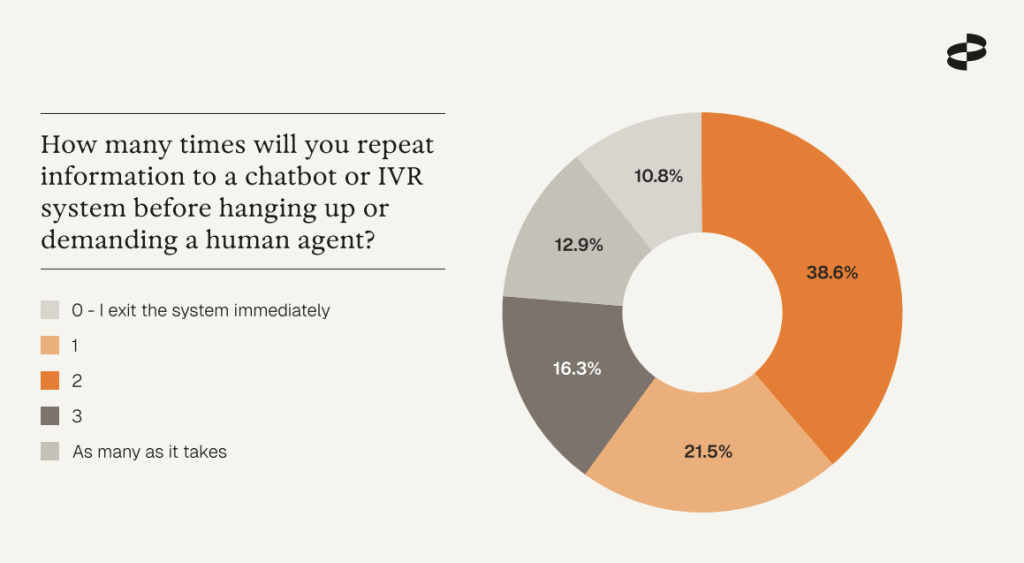
While 13 per cent said they would go over the same details as often as it took to make themselves understood, nearly 32 per cent give up after two attempts. As Parola noted, the data shows that combined, seven out of 10 customers are less than two failed comprehension loops away from abandoning the interaction entirely.

Experienced CX leaders will not be surprised that voice calls remain the most popular support channel. The report’s authors described this as focusing on “the channel that fails them the most,” but that may not be true. There can be an extra cognitive load in having to type and read to get support versus just telling another human being what’s going on.
The research also doesn’t really connect the dots in terms of AI becoming increasingly integrated in IVR systems, which will change how well they might function in the future. You could argue the bar for automation is currently so low that brands have a huge opportunity to improve CX if they deploy the technology wisely.
Parola’s ungated 24-page report offers some helpful numbers for those trying to educate senior executives about the risks of leaving customers dissatisfied. There’s also enough statistics in the online version that you may not need to download the full PDF.
The bottom line is that customers will always be somewhat impatient. The question is whether the experience you’re offering will make the level of their impatience better or worse.


